
TNB Bill Shock in February 2026? AFA Cuts, Solar ATAP Self-Protection, and Why Right-Sized Malaysia Solar Matters
If you felt this when opening your latest TNB bill, you are not alone. The Automatic Fuel Adjustment (AFA) discount quietly shrank again in February 2026, which means you now get less rebate per kWh even if your usage stayed the same. [web:172][web:173]
1. What Changed in the February 2026 TNB AFA Rate?
TNB has confirmed that the AFA rate for February 2026 is -2.77 sen/kWh, down from -4.99 sen/kWh in January 2026 (and -6.42 sen/kWh in December 2025). [web:172][web:173]
January 2026
AFA Discount: -4.99 sen/kWh
Set by the Energy Commission (ST), replacing the old ICPT mechanism. [web:173]
February 2026
AFA Discount: -2.77 sen/kWh
Same usage, smaller discount per kWh = higher bill feeling. [web:172]
For households using more than 1,500 kWh per month, your effective energy cost combines generation, capacity and network charges, totalling about 54.43 sen/kWh before AFA. [web:172] When the AFA rebate drops by 2.22 sen/kWh month-on-month, high-usage families can easily see RM 30–RM 60 difference on their TNB bill without changing any behaviour.
2. Why High-Usage Homes Feel the Pain More
TNB’s tariff structure is tiered. The first 1,500 kWh is charged at 27.03 sen/kWh generation rate, while consumption above 1,500 kWh attracts 37.03 sen/kWh before other components. [web:172][web:174] Add capacity and network charges, and the upper block is where your bill really spikes.
- You depend heavily on the AFA rebate to soften your bill. [web:172][web:173]
- When AFA moves from -4.99 to -2.77 sen/kWh, your “discount” is nearly halved.
- Result: “Same air-cond hours, higher bill” feeling every time AFA tightens.
3. Solar ATAP: Locking in Part of Your TNB Cost
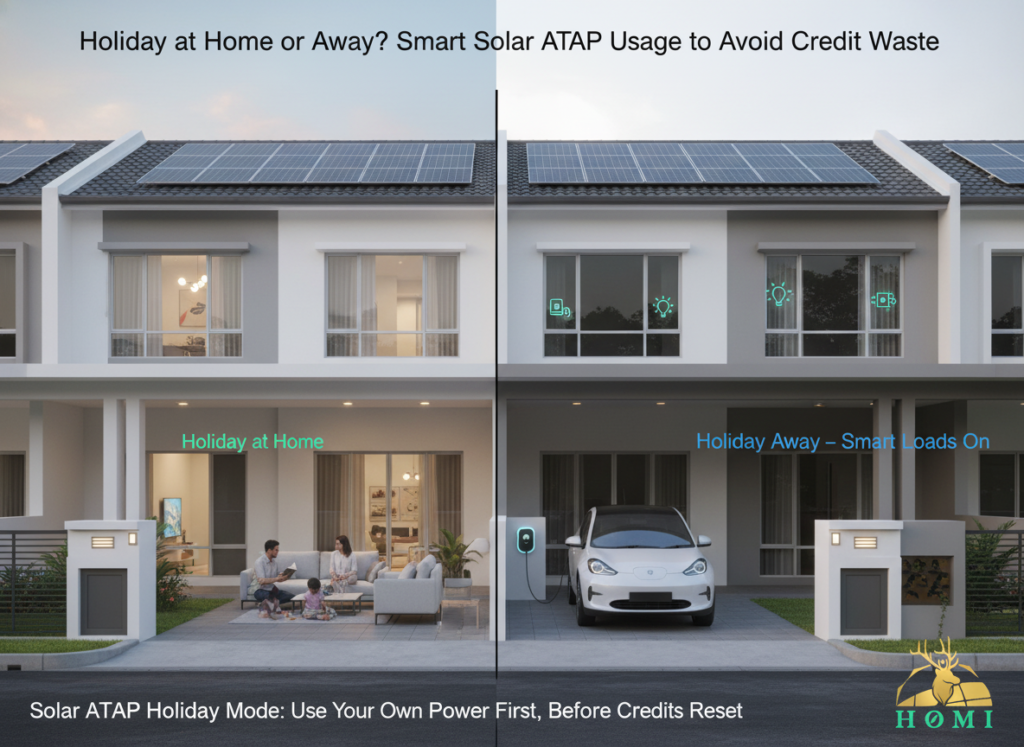
Solar ATAP is designed around true self-consumption: you use your own solar first, and only surplus is exported to TNB for a monthly credit. [web:33][web:44] For domestic users, those credits only offset the energy charge component and expire at the end of each billing cycle. There is no rollover to the next month. [web:33][web:44]
What this means for bill control:
- Every kWh you self-consume is a kWh you do not buy at 54+ sen/kWh (for high-usage tiers). [web:172][web:174]
- This “locks in” a portion of your usage at effectively RM 0 variable cost once your system is paid off.
- You become less exposed to AFA fluctuations because part of your demand never touches TNB’s fuel cost formula.
🔍 Simple AFA Impact & Solar Savings Calculator
Estimate how much the February AFA cut costs you – and how much self-consumption solar could offset.
4. Why Precise Sizing Matters Under ATAP (No Credit Rollover)
Because ATAP credits do not roll over beyond each billing cycle, oversizing your solar system can create a new problem: daytime surplus that expires with zero financial benefit. [web:33][web:44]
Oversized System Scenario
- System generates 1,200 kWh/month.
- Household self-consumes only 800 kWh in daytime.
- Surplus 400 kWh exported – but if this already wipes out the energy charge portion of your bill, extra credits do nothing.
- Any unused credits at month-end simply vanish. [web:33][web:44]
Right-Sized System Scenario
- System generates 900–1,000 kWh/month for the same home.
- Self-consumption 750–850 kWh, with modest export.
- Minimal expired credits, faster payback, higher true ROI.
In short: under ATAP, the best system is not “the biggest your roof can fit”, but the one that matches your actual TNB load profile so almost every kWh produced either directly replaces TNB units or meaningfully offsets your energy charge within the month. [web:33][web:44]
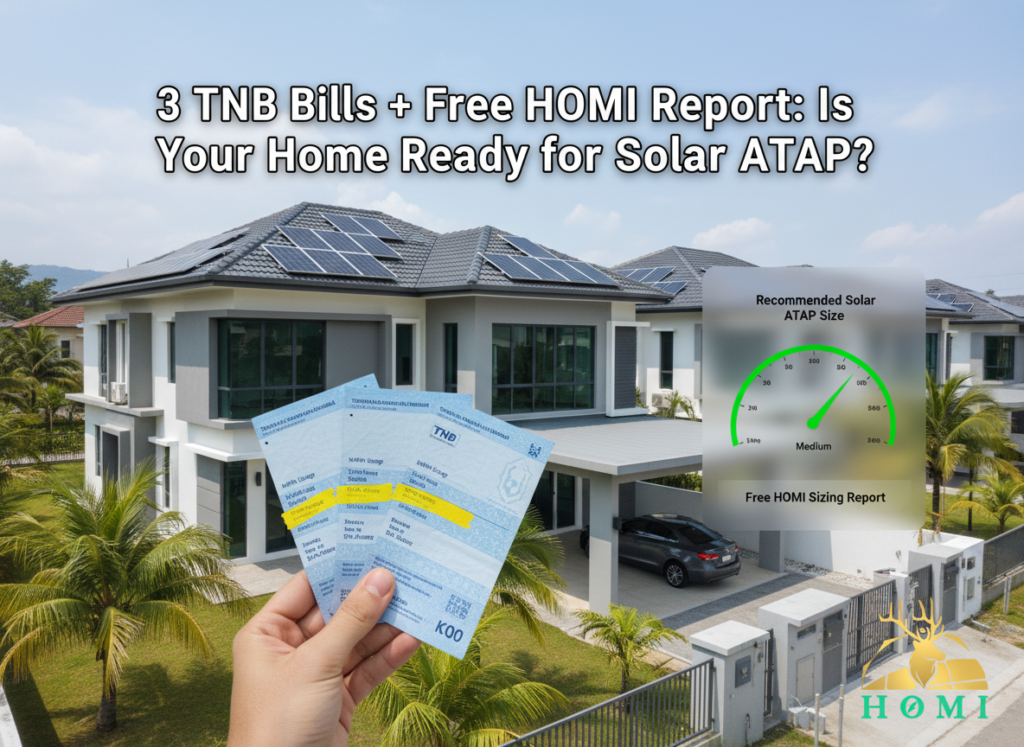
5. HOMI’s Data-Driven “TNB Bill Simulation” Report
HOMI’s consultants use 12–24 months of your real TNB data and the latest AFA and ATAP rules to model your future bills. We combine:
- Current and projected energy + capacity + network charges. [web:172][web:174][web:175]
- ATAP export credit logic (no rollover, energy-charge-only). [web:33][web:44]
- Your family’s day–night usage pattern (air-cond, EV, WFH, travel).
The result is a conservative savings simulation that tells you:
- How much of your bill can be “insulated” from AFA changes.
- What system size avoids chronic surplus and expired credits.
- How your payback looks if AFA gets less generous over time.
FAQ: TNB AFA, Solar ATAP & Tariffs
Why did my February 2026 TNB bill increase even though my usage looks similar?
Because the AFA discount shrank from -4.99 sen/kWh in January to -2.77 sen/kWh in February 2026, your effective per-kWh cost went up even at the same consumption, especially if you use more than 1,000–1,500 kWh per month. [web:172][web:173]
How does Solar ATAP help against AFA changes?
Solar ATAP lets you self-consume your own solar generation before buying from TNB, effectively “locking in” part of your usage cost. Those kWh never see AFA changes or future tariff hikes, as they are covered by your rooftop system once it is paid off. [web:33][web:44]
Why is correct system sizing more important under ATAP than before?
Because ATAP credits expire every billing cycle and only offset energy charges, oversized systems can produce surplus that never reduces your bill once your energy component is fully offset. That unused export is effectively free power to the grid, hurting your ROI. [web:33][web:44]