

TNB Normal vs TOU in 2026: High-Usage Homes + Solar ATAP – How to Pick the Right Combination So You Don’t Choose the Wrong Plan for Your TNB Bill
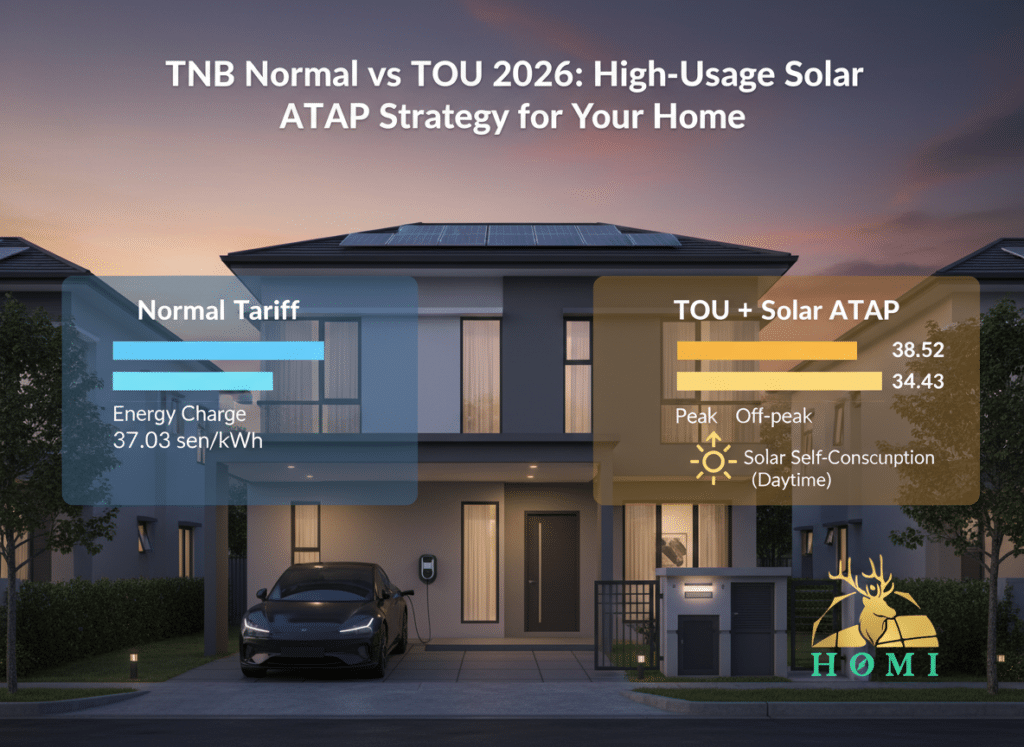
You now have a two-tier Normal tariff (27.03 / 37.03 sen/kWh Energy Charge), a Time-of-Use (TOU) option with peak vs off-peak rates (up to 38.52 / 34.43 sen/kWh for >1,500 kWh), and Solar ATAP on top—with export credits that only offset Energy Charge and reset monthly.
This Q&A-style guide answers the three questions we hear most from high-usage landed homes: “Should I stay on Normal or switch to TOU?”, “If I install Solar ATAP, do I still need TOU?” and “What do 38.52 / 34.43 sen/kWh actually mean for my wallet once I cross 1,500 kWh?”
1. Quick Overview: 2026 Normal vs TOU vs Solar ATAP (High-Usage Focus)
| Item | Normal Tariff (Domestic) | TOU Tariff (Domestic) |
|---|---|---|
| Energy Charge ≤ 1,500 kWh/month | 27.03 sen/kWh (single Energy Charge band up to 1,500 kWh). | Peak 28.52 sen/kWh, Off-peak 24.43 sen/kWh. |
| Energy Charge > 1,500 kWh/month | 37.03 sen/kWh (for all kWh once you exceed 1,500 kWh). | Peak 38.52 sen/kWh, Off-peak 34.43 sen/kWh. |
| Other bill components | Capacity charge 4.55 sen/kWh + Network charge 12.85 sen/kWh + RM10 Retail charge (waived ≤600 kWh), plus AFA and tax. | |
| Solar ATAP interaction | Solar ATAP offsets your Energy Charge via self-consumption first; any export becomes monthly Energy Charge credit only, with no rollover and no cash payout. | |
For high-usage homes (>1,500 kWh/month), the “battle” is between 37.03 sen flat Energy Charge vs a mix of 38.52 sen peak and 34.43 sen off-peak—on top of the same fixed charges and AFA environment.
2. Q1 – “I Use Over 1,000 kWh/Month. Should I Stay on Normal or Switch to TOU?”
Short answer:
If your usage often crosses 1,500 kWh/month and you can shift a meaningful chunk of your non-solar usage to off-peak hours, TOU can beat Normal. If your lifestyle locks most heavy usage into evening peak hours, Normal may still be safer.
Longer explanation:
- Above 1,500 kWh/month, Normal Energy Charge is 37.03 sen/kWh all day.
- TOU splits Energy Charge into 38.52 sen/kWh (peak) and 34.43 sen/kWh (off-peak).
- If too much of your usage happens in TOU peak hours, you end up paying more than 37.03 sen/kWh for those kWh.
- If you shift enough usage into off-peak, you pay closer to 34.43 sen/kWh on those kWh and lower your blended Energy Charge.
TOU is not automatically “cheaper”—it is a tool. It only wins if you actually change when you use electricity.
3. Q2 – “If I Install Solar ATAP, Do I Still Need TOU?”
Solar ATAP changes the game because daytime energy can be provided by your own roof instead of the grid.
Key Solar ATAP rules for domestic users:
- You self-consume solar first in real time; this directly reduces grid kWh and Energy Charge during the day.
- Any surplus becomes a monthly credit that only offsets Energy Charge; no effect on Capacity/Network, no rollover.
- Credits expire each billing cycle, so oversizing for export is less attractive than under NEM.
For high-usage homes, a strong combo is:
- Daytime (roughly 9am–5pm): Use Solar ATAP to cover your basic and moderate loads—fridges, routers, fans, some AC, work-from-home usage.
- Night-time: For remaining kWh, use TOU to shift flexible loads (washing, drying, dishwasher, EV charging, some water heating) into off-peak hours where possible.
Solar ATAP and TOU are not either/or. Solar lowers how much you buy; TOU lowers what you pay for the remaining kWh—if you cooperate with the time bands.
4. Q3 – “What Do 38.52 / 34.43 sen/kWh Actually Mean Once I Cross 1,500 kWh?”
Once your monthly usage is above 1,500 kWh, you effectively enter the “high user” tier under both Normal and TOU.
- Normal: Every kWh is billed at 37.03 sen Energy Charge, no matter what time of day.
- TOU: Each kWh is either 38.52 sen (peak) or 34.43 sen (off-peak) Energy Charge, depending on when you use it.
However, if you rarely shift and most heavy loads run at TOU peak, your blended Energy Charge could easily exceed 37.03 sen/kWh—meaning you would have been better off staying on Normal.
5. Simple Calculator: Normal vs TOU + Solar ATAP for a High-Usage Month
Normal vs TOU + Solar ATAP – High-Usage Home Snapshot
Use this simplified calculator to see how your monthly Energy Charge might change under Normal vs TOU + Solar ATAP. For real decisions, HOMI will model your entire bill structure.
Assumptions: Energy Charge only; Normal = 27.03 / 37.03 sen/kWh; TOU high-usage = 38.52 sen/kWh peak, 34.43 sen/kWh off-peak; solar output used first to offset daytime Energy Charge; export credits beyond Energy Charge are not counted. This is a simplified illustration, not a full bill simulation.
6. How HOMI Helps High-Usage Homes Avoid “Wrong Plan” Mistakes
Many high-usage families ask us: “Just tell me which is better—Normal + Solar or TOU + Solar?” Our honest answer is: it depends on your usage pattern, not on marketing slogans.
- Collect at least 3–12 months of TNB bills (and smart meter data if available) to map your day vs night usage.
- Estimate realistic Solar ATAP generation for your roof and how much will be self-consumed vs exported, month by month.
- Simulate your bill under:
- Normal + no solar,
- Normal + Solar ATAP,
- TOU + no solar,
- TOU + Solar ATAP (with different load-shifting assumptions).
- Show you, in RM, how much each scenario might cost across a full year—not just the “best-case” sunny month.
FAQ: High-Usage Homes, 2026 Tariffs, Solar ATAP and TOU
For a home using more than 1,500 kWh monthly, is TOU always cheaper than Normal once Solar ATAP is installed?
No. For high-usage homes, TOU can be cheaper than Normal only if a significant share of remaining grid usage (after Solar ATAP self-consumption) is shifted into off-peak hours. If you still run most heavy loads during TOU peak periods, you may end up paying more per kWh than under the 37.03 sen/kWh Normal Energy Charge. Solar ATAP reduces daytime Energy Charge under both tariffs, so the decision comes down to how flexible your household is in moving washing, drying, EV charging and some cooling into off-peak windows.
How do Solar ATAP export credits behave under the 2026 rules?
Under Solar ATAP, domestic export credits are applied only to the Energy Charge component of your TNB bill. You cannot use them to offset Capacity or Network charges, AFA, taxes or other fees, and they do not roll over beyond the billing cycle. Any unused credits at the billing cut-off are forfeited. This is different from NEM 3.0, where unused credits could roll forward for up to 12 months. The new rules make system sizing and self-consumption strategy much more important.
What information does HOMI need to recommend between Normal vs TOU + Solar ATAP for my family?
HOMI usually asks for three to twelve months of TNB bills, any available smart meter interval data, a rough breakdown of your major loads (number of air-conditioners, electric water heaters, EV or dryer) and your typical daily schedule (who is home when, and which loads can be shifted). With this information, HOMI can model realistic Solar ATAP generation on your roof, apply both Normal and TOU Energy Charge patterns and provide a clear comparison of annual costs under each combination.