


Zero-export solar in Malaysia: what an export limiter changes—and what it does not
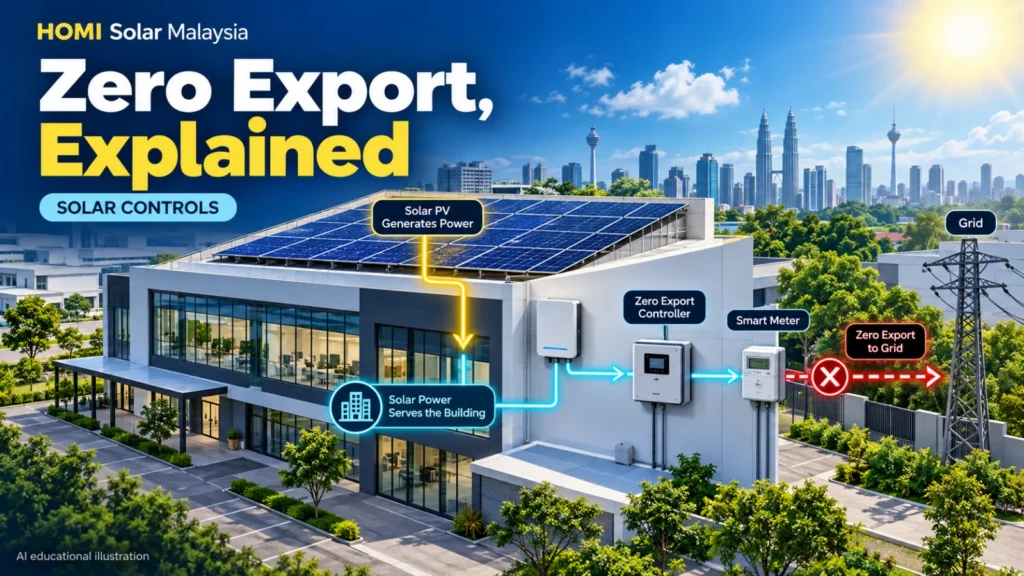
Zero-export solar is not the same as a solar system that never changes output. It is a grid-connected control arrangement intended to keep solar generation within the premises instead of sending power to the utility grid. As the building load moves, an export limiter measures the flow near the point of interconnection and tells the inverter or plant controller to raise, reduce or curtail solar output.
For grid-connected self-consumption in Peninsular Malaysia, the Energy Commission’s 2026 SELCO guideline says no power evacuation to the grid is allowed at any time and appropriate equipment must prevent inadvertent export. That requirement defines the outcome. It does not mean that buying a controller alone completes the scheme, protection, study, registration or commissioning work.
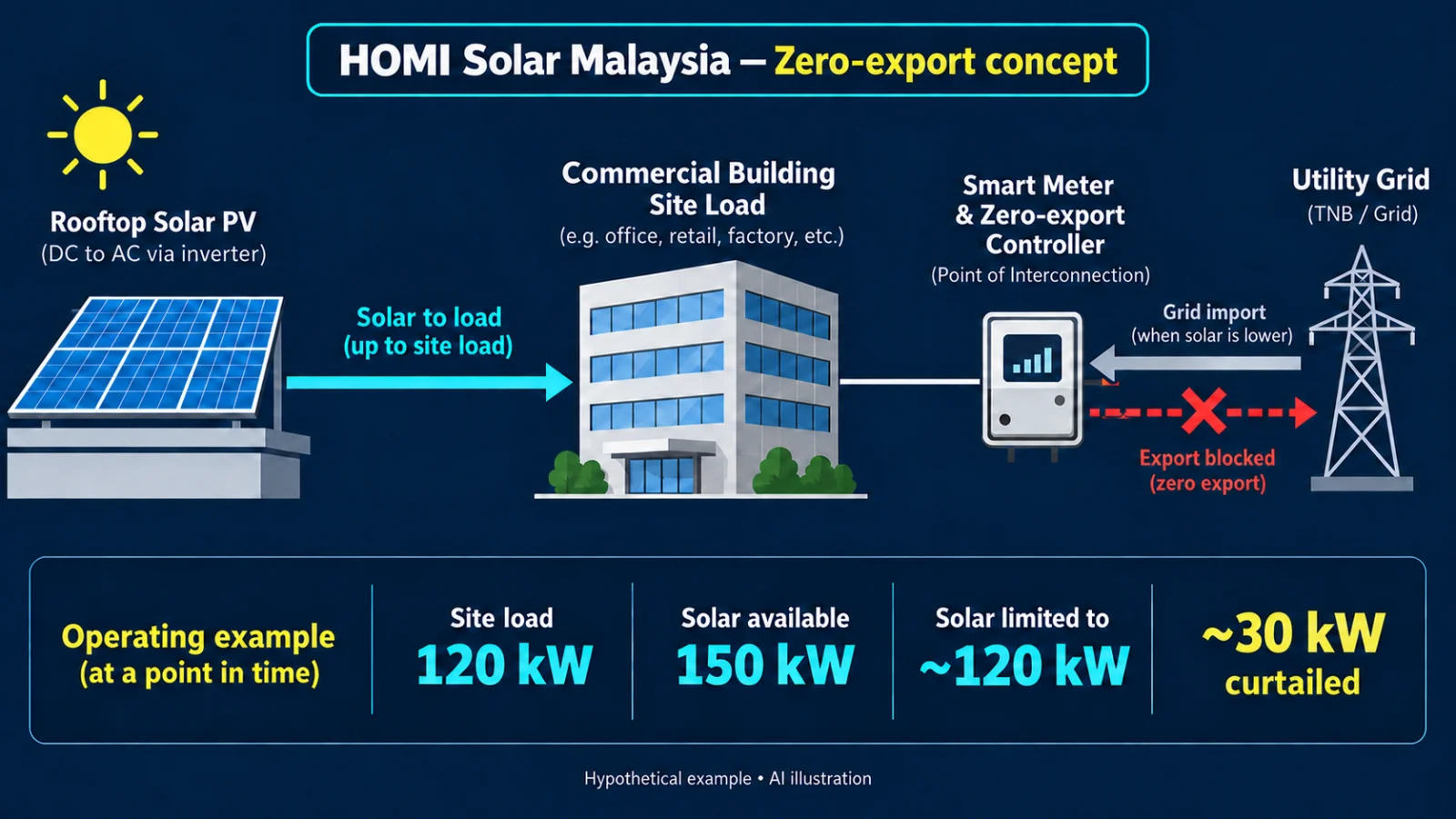
What the controller is actually watching
Think of the meter at the grid boundary as a traffic observer. If the premises is importing 40 kW while rooftop solar is producing 80 kW, the building may be using 120 kW in total. If site demand falls while sunlight remains strong, the controller must reduce the solar command before surplus power crosses the boundary.
The result depends on the current transformer orientation, meter location, sampling speed, communications, inverter response, fail-safe setting and the loads included behind that boundary. A diagram that omits a second transformer, generator, battery or tenant distribution board can make a control concept look correct while measuring the wrong system.
Worked example: load matching and curtailment
Hypothetical only: the numbers below are not measured HOMI project data, a quotation, a savings forecast or a recommended design.
| Moment | Site load | Available solar | Controller response | Grid position |
|---|---|---|---|---|
| Bright midday | 120 kW | 150 kW | Limit solar to about 120 kW; roughly 30 kW of available output is curtailed. | Target approximately zero export, subject to the engineered control tolerance and transient behaviour. |
| A cloud passes | 120 kW | 80 kW | Allow the available 80 kW. | Import about 40 kW to meet the load. |
| Major load switches off | 70 kW | 130 kW | Rapidly reduce the solar command toward the new load. | The protection and control design must manage the transition; the table is not a commissioning test. |
| Meter or communications fault | Unknown | Variable | Use the documented fail-safe response selected by the competent designer. | Do not assume the plant may continue at full power. |
This example also shows the commercial trade-off: a system can be physically capable of producing more than the site is using, yet zero-export control may deliberately leave some solar energy unused. Oversizing without a verified daytime load profile can therefore create more curtailment, not automatically more useful energy.
What an export limiter does not provide
- It does not turn SELCO into NEM or Solar ATAP, and it does not grant permission to export.
- It does not keep the building powered during a blackout unless a separately designed backup system provides intentional islanding and protection.
- It does not replace the connection assessment, self-assessment, competent-person work, protection coordination, testing or current scheme documents that apply to the exact site.
- It does not prove savings. Useful generation still depends on irradiance, shading, downtime, load timing, tariffs and actual curtailment.
Questions to answer before design approval
- Which current scheme applies to this exact premises, consumer and capacity?
- Where is the legal and electrical point of interconnection, and which loads sit behind it?
- Do interval data show weekday, weekend, holiday and seasonal minimum daytime demand?
- What happens if a meter, current transformer, network link, controller or inverter stops responding?
- Which signals and events will be logged so the operator can distinguish low sunlight from commanded curtailment?
- Who is responsible for testing, settings control, periodic verification and change management after new loads are added?
For installations above 72 kWac, the current Energy Commission guideline describes a connection assessment study using before-and-after load profiles and other technical factors. Installations up to 72 kWac may be subject to self-assessment requirements. The exact current route should be checked for the specific capacity and consumer category rather than inferred from this article.
Operational records worth keeping
Keep the approved single-line diagram, controller make and model, current-transformer ratio and orientation, firmware and configuration version, fail-safe setting, test record, responsible competent person, commissioning date and any later change record. Trend both site load and controller-limited solar output. A recurring gap between available and dispatched solar may be expected curtailment, a control-setting issue or a measurement problem; it needs evidence, not guesswork.
Homi Solar Malaysia can help review the site boundary, daytime load evidence and zero-export design questions before a proposal is treated as final. See the current solar service route or contact a person at HOMI. Keep private bills, account numbers and customer data out of public comments and AI tools.
Regional boundary: This article is general education based on official information checked on 12 October 2026. The cited SELCO and NEM documents apply to Peninsular Malaysia. Sabah and Sarawak projects must confirm the current local utility and regulatory requirements. This is not approval, electrical design, commissioning instruction, legal advice or a guaranteed zero-export performance claim.
Frequently asked questions
Does zero export mean the solar system always generates exactly the building load?
No. The controller attempts to keep power from flowing out to the grid, but available sunlight, inverter limits, sampling and response time, control margins and rapidly changing loads all affect operation. The exact design and test acceptance criteria belong to the competent project team.
Can an export limiter replace the SELCO application or assessment?
No. It is one control component within the installation. The current scheme, capacity, assessment path, protection, competent-person work, documentation and commissioning still have to be established for the exact premises.
Will a zero-export solar system work during a blackout?
Not by default. A normal grid-connected inverter typically needs grid conditions and must follow its approved protection behaviour. Backup requires a separately engineered system with suitable switching, protection and operating boundaries.
Why might the system curtail solar at noon?
If available solar exceeds the load behind the controlled grid boundary, reducing solar output is how a zero-export design avoids surplus power. Load-profile evidence helps estimate how often that may happen before sizing is finalised.
Official sources checked
- Energy Commission: SELCO guideline, revision 15 June 2026
- Energy Commission: NEM Rakyat and NEM GoMEn guideline page, Revision 1/2026
- SEDA Malaysia: official SELCO overview
This article reflects official information checked on 12 October 2026 and is general guidance. Programme rules, tariff treatment, approval and actual savings remain subject to the latest PETRA, SEDA, Energy Commission and TNB requirements plus the property bill, roof and usage pattern.
Want HOMI to review your TNB bill?
Send your usage pattern and HOMI can estimate whether Solar ATAP makes sense for your home or business.
Arrange a Zero-Export Solar Review