
Hari Raya Factory Shutdown: How to Use Solar ATAP’s 100% Maximum Demand Policy to Upgrade or Expand Your Commercial Solar System Without Wasting Generation
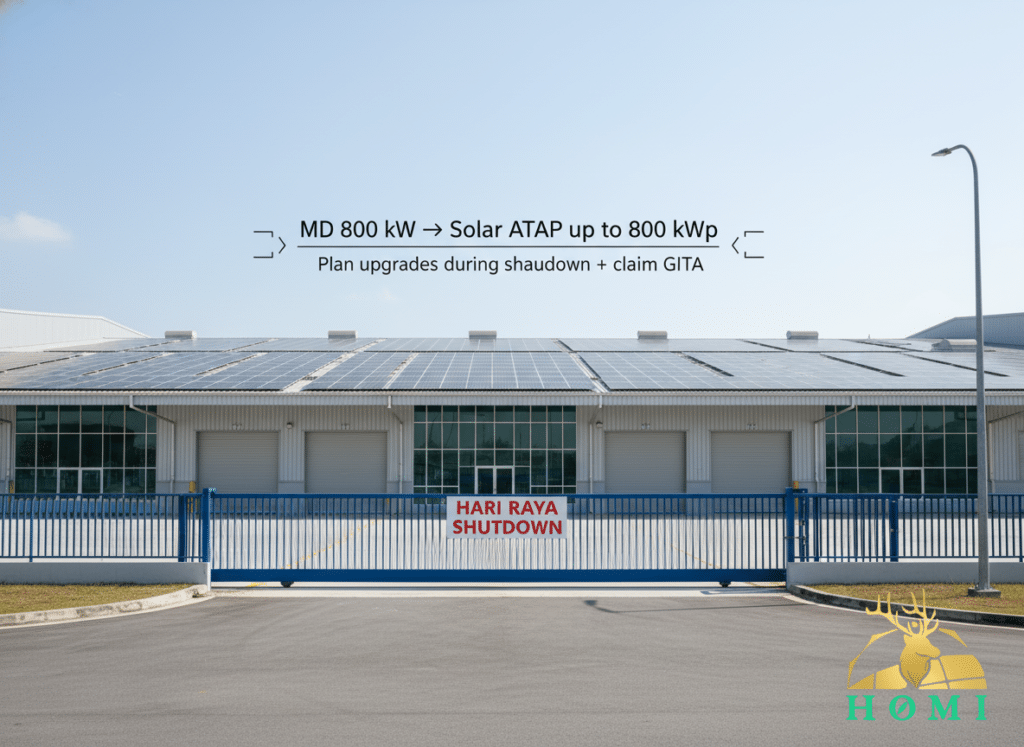
For business owners, that shutdown is not just a cost—it is also the perfect window to carry out solar upgrades, wiring works and ATAP system expansion without disrupting production.
With Solar ATAP, non‑domestic users can now install rooftop PV systems up to 100% of their Maximum Demand (MD), capped at 1 MW per account. Used wisely and combined with incentives like GITA, this can transform your long-term electricity cost—but if you simply “max out” 100% MD without understanding your load curve, you risk wasting generation on weekends and shutdown days.
1. Why Hari Raya Shutdown Is a Strategic Window for Solar Projects
In 2026, many industrial areas in Malaysia are closing for Hari Raya from Friday through Monday, with some factories taking a full 7–10 day shutdown. [web:472][web:474][web:476]
- Production lines are idle, so power interruptions and roof access work do not affect output.
- Scaffolding, crane access and electrical tie‑ins can be done with minimal safety and scheduling conflicts.
- Management has a clear cut‑off to plan “before Raya” approvals and “during Raya” installation works.
Instead of viewing shutdown as dead time, many forward‑thinking factory and SME owners now treat Raya as a scheduled “solar upgrade window”.
2. Solar ATAP 100% Maximum Demand – Policy Advantage and Hidden Risk
Solar ATAP has significantly relaxed capacity limits for businesses compared to earlier NEM schemes.
| Consumer Type | Solar ATAP Capacity Limit | Key Notes |
|---|---|---|
| Domestic (Single Phase) | Up to 5 kWac | Small landed homes. [web:370][web:386][web:33][web:368] |
| Domestic (Three Phase) | Up to 15 kWac | CCC or technical checks above thresholds. [web:370][web:386][web:33][web:368] |
| Non‑Domestic (Commercial / Industrial) | Up to 100% of MD, capped at 1 MW | Subject to technical assessment (e.g. CAS above 72 kW). [web:370][web:386][web:33][web:466][web:368][web:422][web:413] |
- You can now size solar to match your full Maximum Demand, not just 50–75% as under many earlier rules. [web:386][web:33][web:471][web:422]
- This is powerful for day‑heavy operations (9am–6pm) with strong base load and cooling. [web:33][web:368][web:422]
- However, if you push to 100% MD without studying off‑days and shutdown periods, you may export large amounts when your plant is idle, with limited financial return. [web:33][web:368][web:473]
3. Export and Credit Reality for Businesses Under Solar ATAP
For non‑domestic users, ATAP export is still based on an energy offset concept, but the value of exported kWh depends on the applicable rate (and may not match your full blended tariff). [web:370][web:386][web:33][web:471][web:368][web:422][web:473]
- ATAP aims to optimise self-consumption and offset a significant portion of your energy usage. [web:386][web:370][web:33][web:368]
- Excess generation on weekends or long shutdowns can be exported but may yield lower effective value than self‑consumed kWh, and cannot fully replace careful load‑matching design. [web:33][web:368][web:473]
- The programme does not offer unlimited cash‑out for surplus; unused benefits can be diluted by operational patterns. [web:386][web:370][web:33][web:471][web:473]
For factories and SMEs, the best Solar ATAP ROI still comes from matching system size to real weekday demand, not from turning your roof into a “solar farm” that mostly exports when you are closed.
4. Simple 100% MD + GITA Planning Calculator (Illustrative)
100% MD & GITA – Quick Planning Snapshot
Use this simple calculator to visualise how much of your MD you might convert into solar capacity and what GITA could do to your project cost.
Assumptions: Target solar size ≤100% MD, capped at 1 MW; simple CAPEX = kWp × RM/kWp; GITA tax savings approximated as CAPEX × tax rate (based on 100% allowance against 70% of statutory income); actual savings depend on MIDA approval and your profit profile. [web:386][web:370][web:33][web:466][web:368][web:422][web:415][web:475][web:473][web:477]
5. Hari Raya Shutdown Checklist: Expanding Solar Without Overdoing 100% MD
Combining the 100% MD allowance, GITA’s final years and a planned Raya shutdown, a typical SME or factory can follow a simple decision flow.
- Compile 12 months of MD data and half‑hourly kWh profiles to see weekday vs weekend, peak vs shutdown demand. [web:368][web:422]
- Identify your “core daytime loads” (cooling, compressors, process lines) that run on typical production days.
- Decide a sensible solar target (e.g. 60–80% of MD) that closely matches daytime load rather than blindly taking 100% MD.
- Prepare GITA application documents and submit to MIDA before commissioning to secure tax benefits. [web:415][web:475][web:473][web:477]
- Schedule structural mounting, DC stringing, main AC tie‑ins and protection upgrades while lines are off.
- Perform preventive maintenance on existing solar systems while access is easy.
- Run initial commissioning and test exports with minimal production risk.
- Fine‑tune inverter settings and load scheduling so weekday generation closely tracks your MD curve.
- Track how much generation occurs on non‑production days and consider future demand‑side measures (e.g. ice‑storage, pre‑cooling) if waste is significant.
6. How HOMI Designs 100% MD Solar ATAP Around Your MD Curve, Raya Shutdown and GITA Timeline
HOMI’s role is to sit between policy and your real‑world factory or SME operations.
- Analysing 12–24 months of MD data and load curves (weekday, weekend, shutdown) to find the “true” useful solar band. [web:368][web:422]
- Proposing one or more solar sizes (e.g. 60%, 80%, 100% of MD) with estimated self‑consumption vs export on working days and shutdown days.
- Integrating GITA and other incentives into the model so you see net cost after tax savings, not just gross CAPEX. [web:415][web:475][web:473][web:477]
- Coordinating installation and tie‑in during Hari Raya or other planned shutdowns to minimise production impact.
- Preparing technical documentation (CAS/PSS support, single‑line diagrams) to meet Solar ATAP guidelines and utility requirements. [web:386][web:370][web:33][web:466][web:413]
FAQ: 100% MD Solar ATAP, Hari Raya Shutdowns and GITA for Factories & SMEs
Does Solar ATAP really allow my factory to install solar up to 100% of Maximum Demand?
Yes. Under Solar ATAP, non-domestic consumers can install solar PV systems up to 100% of their contracted Maximum Demand, subject to a cap of 1 MW per TNB account and technical assessment by the utility and regulator. This is a step up from many earlier schemes that limited commercial solar capacity to a smaller share of MD. However, reaching 100% MD is optional, not mandatory, and it is essential to ensure that the proposed system size matches your typical daytime load and does not result in excessive exports during non-production days.
Why is Hari Raya shutdown often used as an installation window for commercial solar projects?
Hari Raya Aidilfitri typically brings a multi-day shutdown for many Malaysian factories, warehouses and SMEs, with both offices and production floors closed. This period reduces the operational risk of isolating electrical circuits, accessing roofs with cranes or scaffolding and performing tie-ins at the main switchboard. It also minimises the chance of unplanned downtime impacting customers, since production is already paused. For these reasons, many owners schedule major solar installations, expansions and preventive maintenance during Raya or similar long public holiday blocks.
How does GITA interact with a 100% MD Solar ATAP project, and why is timing important?
Green Investment Tax Allowance (GITA) allows eligible companies to claim up to 100% of their solar project capital expenditure as a tax allowance, which can be used to offset up to 70% of statutory income. For example, a RM500,000 solar project at a 24% corporate tax rate can generate around RM120,000 in tax savings. 2026 is currently one of the final years to claim GITA for many commercial and industrial projects, so it is important to submit applications to MIDA before the system is commissioned. Combining GITA with Solar ATAP’s 100% MD allowance and a well-timed shutdown can significantly improve ROI and shorten payback periods.