


Why is my solar battery holding charge?
When grid power is available, a solar battery may pause discharge at its backup reserve so it has charge left if the grid fails. Check the app’s operating mode and reserve before assuming a fault. An outage changes what the system is allowed to supply, and only a configured backup system can use its backup range. Homi Solar Malaysia suggests asking your installer to identify both limits and show how they behave on your model.
Read two different limits
The Berkeley Lab reserve study separates energy set aside for unexpected interruptions from energy available for daily use. On some systems the inverter can draw on the reserve during a blackout until the equipment’s lower protection limit. The Sunny Island planning manual is a product example that lists self-consumption, backup and protection ranges separately. Its published settings apply to that example and are not used here as recommendations.
Follow the energy at each stage
| Condition | Question to ask | Illustrative energy |
|---|---|---|
| Grid on at 60% | How far may normal discharge go? | To the 30% reserve: 3 kWh before losses. |
| Grid on at 30% | Does the reserve hold here? | 0 kWh for daily discharge in this mode. |
| Outage starts at 30% | Which circuits can use reserve? | Down to the 10% backup floor: 2 kWh before losses. |
Hypothetical calculation: All percentages use one illustrative 10 kWh scale, with 30% held while the grid is available and 10% as the lower limit during backup. Multiply the difference in percentage points by 10 kWh: (60% − 30%) × 10 = 3 kWh, or (30% − 10%) × 10 = 2 kWh. This is energy on the example’s battery scale. Conversion losses, actual charge when the outage starts, output in kW and connected circuits all affect what appliances receive. App percentages and quoted usable capacity may use different denominators.
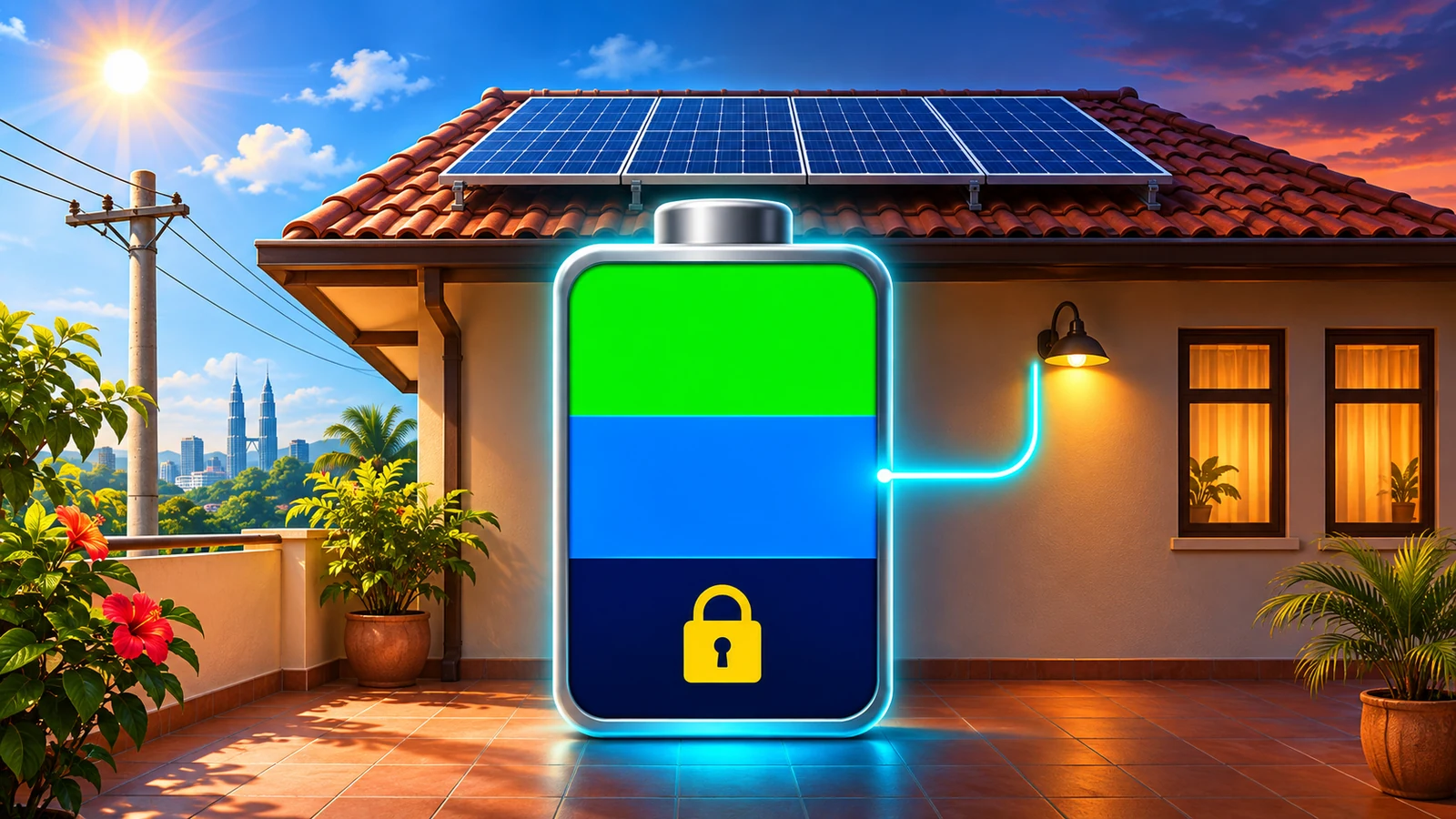
Check the grid-on pause
Note whether the grid was available, the displayed charge and reserve, the mode and time, and whether the app showed an alert. If the battery stops above the expected reserve, schedules or other controls may also be involved. Ask the installer for the behaviour of the installed model and firmware. Use the system’s existing status display and keep controls as set until the installer explains them.
Ask at handover
- Ask which displayed limit applies with the grid on and which applies during a backup event.
- Ask what capacity the displayed percentage refers to.
- List backed-up circuits and the permitted backup output in kW.
- Ask for an installer-led demonstration of the transition and how charge recovers.
- Save the mode, timestamp and any alert for follow-up.
Sources checked on 13 November 2026. The June 2026 Energy Commission guideline covers self-consumption PV in Peninsular Malaysia. Confirm the applicable local requirements for the actual site, including Sabah or Sarawak. No tariff or reserve percentage is recommended here. Speak to the Homi Solar Malaysia team or see our solar services. Use an agreed private channel for bills or screenshots with account or address details, and keep them out of public comments and AI tools.
Common questions
Is the reserve the same as the minimum charge?
On some systems the reserve controls everyday discharge while the lower protection limit restricts discharge during backup. Ask what your two limits mean.
Does a 30% reserve guarantee 30% for backup?
No. The actual charge when power fails and the lower operating limit both matter. The battery and inverter also have output limits.
Why is the battery below the selected reserve?
The reserve is a control setting, and may differ from current charge. Check recent outage or charging history and ask the installer to explain the gap.
Will every socket work in an outage?
Only circuits included in the backup design can be expected to receive power, subject to the equipment and its output limits.
Source notes
- Bill Savings vs. Backup Power: Evaluating Operational Tradeoffs for Home Solar+Storage Systems — Lawrence Berkeley National Laboratory
- Battery Use by the Sunny Island — SMA Solar Technology AG
- Guidelines for Solar Photovoltaic for Self-Consumption in Peninsular Malaysia — Suruhanjaya Tenaga
This article reflects official information checked on 13 November 2026 and is general guidance. Programme rules, tariff treatment, approval and actual savings remain subject to the latest PETRA, SEDA, Energy Commission and TNB requirements plus the property bill, roof and usage pattern.
Want HOMI to review your TNB bill?
Send your usage pattern and HOMI can estimate whether Solar ATAP makes sense for your home or business.
Discuss Your Battery Reserve